9 Easy Steps to Perfect Marble Countertop Manufacturing Process

Marble Countertop Manufacturing Process | Dongxing Marble

If you’re looking for a detailed guide on the marble countertop manufacturing process, you’ve come to the right place. This article breaks down every step from raw block extraction to finished product, helping homeowners, interior designers, and B2B buyers understand how high-quality marble countertops are made.
Marble countertops are a timeless choice for high-end homes, hotels, villas, and commercial spaces. They are beloved for their naturally unique veins, luxurious texture, and long-lasting durability—key reasons why the marble countertop manufacturing process requires precision and expertise.

For homeowners, interior designers, and B2B buyers alike, understanding the marble countertop manufacturing process is crucial. It helps you identify high-quality marble countertop products, avoid purchasing pitfalls, and make informed decisions when selecting suppliers or customizing your ideal countertop.

Marble Manufacturing Process

1. Quarrying: Extracting Raw Marble Blocks (The Foundation of Quality)

Every natural marble countertop starts with raw marble blocks, which are extracted from natural quarries around the world.
Marble is a metamorphic rock formed over millions of years from limestone, and its quality—including color, vein pattern, density, and durability—is determined from the moment it’s quarried.
This step is critical: low-quality raw blocks will lead to flawed countertops, no matter how precise the subsequent processing.
The quarrying process involves several key steps:
  • Site Exploration & Assessment: Before mining, geologists and engineers conduct detailed surveys to identify high-quality marble deposits. They test the rock’s density, hardness, and color consistency to ensure it meets the standards for countertop production. Only deposits with minimal cracks, impurities, and stable color are selected for extraction.
  • Marking & Cutting: Workers use professional tools (such as diamond wire saws and hydraulic splitters) to mark the marble ore body and cut it into large, manageable raw blocks. This process requires precision to avoid damaging the rock—any cracks or chips during quarrying will render the block unusable for high-end marble countertops.
  • Extraction & Transportation: Once the raw blocks are cut, cranes and heavy machinery are used to lift them from the quarry. The blocks are then loaded onto trucks and transported to the stone processing factory, wrapped in protective materials to prevent scratches, cracks, or impact damage—critical for preserving the integrity of the raw material.
Key Quality Check: High-quality raw marble blocks should have a dense structure, no obvious cracks or holes, and consistent color and vein patterns.
Reputable marble suppliers only source raw blocks from well-known quarries (such as those in Italy, Spain, or China) to ensure consistency and quality for countertop production.
Workers extracting raw marble blocks in a quarry for marble countertop manufacturing
Related: Top Marble Quarries Around the World: Source of High-Quality Raw Materials

2. Block Cutting: Transforming Raw Blocks into Marble Slabs

Once the raw marble blocks arrive at the processing factory, the next step is to cut them into thin, flat marble slabs—the base material for countertops.
This step requires advanced equipment and precision to ensure the slabs are uniform in thickness, flat, and free of defects; any imperfection here will affect the final marble countertop quality.
The block cutting process is as follows:
  • Block Preparation: First, workers clean the raw blocks to remove dirt, dust, and loose debris. They then inspect the blocks again to identify any hidden cracks or flaws missed during quarrying—blocks with serious defects are discarded or used for lower-grade products, not high-end countertops.
  • Slab Cutting with Infrared Bridge Saws: The most common equipment for this step is a large infrared bridge saw, which uses a diamond blade to cut the raw block into slabs. The infrared positioning system ensures straight, precise cuts, and the blade is designed to cut through marble without chipping or damage, preserving the slab’s integrity.
  • Thickness Selection: The thickness of the marble slabs depends on the customer’s needs and intended use. The most common thicknesses for marble countertops are 18mm (0.7 inches), 20mm (0.8 inches), and 30mm (1.2 inches). Thicker slabs (30mm) are more durable for high-traffic areas like commercial kitchens, while 18mm-20mm slabs are ideal for residential marble countertops.
Key Quality Check: After cutting, each slab is inspected for flatness, thickness consistency, and surface defects.
The slab should be perfectly flat (no warping), with a thickness variation of no more than 0.5mm.
Any slabs with chipped edges or uneven surfaces are sent for reprocessing or discarded, ensuring only high-quality slabs move to the next step of marble countertop production.
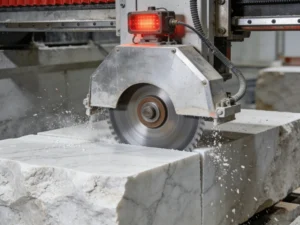
Infrared bridge saw cutting raw marble block into slabs for countertops

Related: Marble Slab Thickness Guide: Which Thickness Is Right for Your Countertop?
3. Slab Selection & Layout: Ensuring Uniformity & Aesthetics

After cutting, the marble slabs are sorted and selected based on the customer’s order requirements.
This step is especially important for custom marble countertops, as it ensures the final product has a consistent appearance—no mismatched colors or disjointed veins that would compromise the overall aesthetic.
The slab selection and layout process includes:
  • Slab Sorting: Workers sort the slabs by color, vein pattern, and quality, grouping slabs with similar characteristics to ensure a uniform look for a single countertop or set of countertops (e.g., for a kitchen with multiple workstations).
  • Layout & Numbering: For custom marble countertop orders, slabs are laid out according to the customer’s CAD design drawings to simulate the final installation effect. Workers then number the slabs to ensure they are installed in the correct order, preserving the continuity of the vein pattern—critical for large marble countertops that require multiple slabs joined together.
  • Customer Confirmation: Reputable marble factories provide photos or videos of the selected slabs to the customer for confirmation before further processing, ensuring satisfaction with the color and vein pattern and avoiding misunderstandings later in the marble countertop manufacturing process.
Key Quality Check: The selected slabs should have consistent color and vein patterns, with no obvious color differences or defects.
The layout should ensure veins flow naturally across the marble countertop, creating a seamless and aesthetically pleasing appearance.
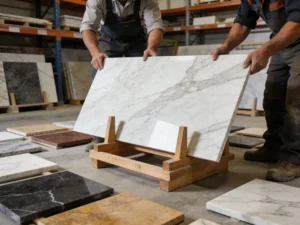
Workers laying out marble slabs for custom countertop selection

Related: How to Choose the Right Marble Slab for Your Custom Countertop
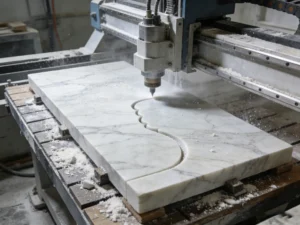
4. Precision Cutting: Shaping the Countertop to Size

Once the slabs are selected and confirmed, the next step is to cut them into the exact shape and size of the countertop, based on the customer’s design drawings or on-site measurements.
This step requires high precision—any error in cutting will affect the installation and overall appearance of the marble countertop.
The precision cutting process involves:
  • CAD Design & Programming: The customer’s design drawings are loaded into a computer-aided design (CAD) system, which generates a cutting path for the CNC machine. The programming includes the marble countertop’s shape, size, and any cutouts (for sinks, cooktops, faucets, etc.).
  • CNC Cutting: A CNC (Computer Numerical Control) cutting machine cuts the marble slab according to the programmed path, using a diamond blade and precise positioning to ensure cuts are accurate to within 0.1mm. This step includes cutting the main marble countertop shape and cutouts for sinks, cooktops, and other fixtures.
  • Edge Trimming: After the main cutting is complete, workers trim the edges of the marble countertop to remove rough spots or chipped edges, preparing it for the next step (edge profiling) in the manufacturing process.
Key Quality Check: The cut marble countertop should match the design drawings exactly, with no errors in size or shape.
The cutouts for sinks and cooktops should be precise, with smooth edges and no cracks.
Any errors in this step can be costly to fix, so strict quality control is essential for high-quality marble countertops.
Freshly cut marble slab with uniform thickness for marble countertops

Related: CNC Cutting for Marble Countertops: Ensuring Precision and Perfection
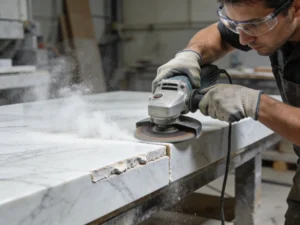
5. Edge Profiling & Shaping: Adding Style and Functionality

Edge profiling is one of the most important steps in marble countertop production—it not only enhances the countertop’s aesthetic appeal but also improves its functionality, such as preventing sharp edges that can cause injury.
The type of edge profile depends on the customer’s style preference and the intended use of the marble countertop.
Common edge profiles for marble countertops include:
  • Straight Edge: A simple, clean edge that is easy to clean and fits modern or minimalist styles. It is the most common and cost-effective edge profile for marble countertops.
  • Round Edge (Bullnose): A rounded edge that is safe for homes with children or pets, as it eliminates sharp corners. It has a soft, classic look that fits most design styles for residential marble countertops.
  • Ogee Edge: An elegant, decorative edge with a curved top and bottom, perfect for traditional or European styles. It adds a touch of luxury to high-end marble countertops.
  • Bullnose with Bevel: A combination of a rounded edge and a beveled edge, offering both safety and style. It is a popular choice for residential kitchens and bathrooms with marble countertops.
  • Custom Edge Profiles: For customers with unique design needs, factories can create custom edge profiles (such as waterfall edges, mitered edges, or decorative grooves) to match specific marble countertop designs.
The edge profiling process uses a specialized edge grinding machine, which grinds and polishes the edge of the marble countertop to the desired profile.
Workers also refine the cutouts (sink, cooktop) to ensure the edges are smooth and consistent with the main marble countertop edge.
Key Quality Check: The edge profile should be smooth, even, and consistent throughout the marble countertop.
There should be no rough spots, chips, or uneven grinding, and the edge should be aligned with the countertop surface, with no gaps or unevenness.
Worker using edge grinding machine to shape marble countertop edge

Related: Marble Countertop Edge Profiles: Which Style Is Right for You?
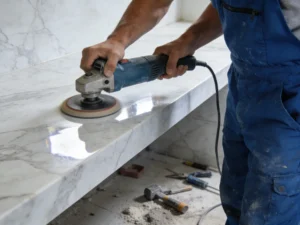
6. Grinding & Polishing: Achieving a Luxurious Shine

Grinding and polishing are critical steps that determine the final appearance and texture of the marble countertop.
The goal is to create a smooth, glossy surface that highlights the natural beauty of the marble’s veins and color, achieved through multiple stages of grinding and polishing with progressively finer abrasives.
This shine is a key factor in the luxury appeal of marble countertops.
The grinding and polishing process for marble countertops is as follows:
  1. Rough Grinding: The first stage uses a coarse abrasive (40-80 grit) to flatten the marble countertop surface and remove scratches or imperfections from cutting and edge profiling, ensuring the surface is even and smooth.
  2. Medium Grinding: The second stage uses a medium abrasive (120-240 grit) to remove scratches left by rough grinding, refining the surface for the final polish.
  3. Fine Grinding: The third stage uses a fine abrasive (400-800 grit) to further refine the surface, eliminating remaining scratches and enhancing the marble’s natural color and vein pattern.
  4. Polishing: The final stage uses a polishing compound (1000+ grit) or diamond polishing pad to achieve a high-gloss, mirror-like finish. This process brings out the full beauty of the marble, making veins more vivid and the surface smooth to the touch—a signature of high-quality marble countertops.
Key Quality Check: After polishing, the marble countertop surface should be smooth, with no scratches, streaks, or dull spots.
The gloss level should be consistent throughout the surface (usually 80-90 gloss units for high-end marble countertops).
The natural veins and color of the marble should be clearly visible and enhanced by the polish.
Worker polishing marble countertop to achieve mirror finish

Related: Marble Countertop Polishing: How to Achieve a Mirror Finish
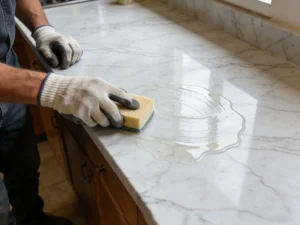
7. Surface Protection Treatment: Enhancing Durability & Stain Resistance

Natural marble is a porous stone, meaning it can absorb liquids and stains (such as coffee, wine, soy sauce, or oil) if not properly protected.
Surface protection treatment is essential—it extends the life of the marble countertop and makes it easier to clean and maintain, which is critical for both residential and commercial use.
The surface protection process for marble countertops includes:
  • Cleaning & Drying: Before applying the protective agent, the marble countertop is thoroughly cleaned to remove dust, dirt, or polishing residue, then dried completely to ensure the protective agent penetrates the stone effectively.
  • Applying Penetrating Sealant: A high-quality penetrating sealant is applied to the marble countertop surface, penetrating the stone’s pores to create a barrier against liquids and stains. Unlike surface sealants, penetrating sealants preserve the marble’s natural look while providing long-lasting protection for the countertop.
  • Curing: The sealant is left to cure for 24-48 hours (usually) to fully bond with the marble, and the countertop is not touched or used during this time to avoid damaging the sealant.
  • Back Reinforcement (Optional): For thinner slabs (18mm-20mm) or marble countertops with large overhangs, a back reinforcement layer (such as fiberglass or resin) may be applied to increase durability and prevent cracking.
Key Quality Check: After the sealant is applied, the marble countertop should repel liquids (water should bead up on the surface).
The sealant should be evenly applied, with no streaks or missed areas.
A quality sealant can last 1-3 years, depending on the marble countertop’s usage and maintenance.
Worker applying penetrating sealant to marble countertop for stain resistance

8. Quality Inspection & Packaging: Ensuring Perfection Before Delivery

Before the finished marble countertop is shipped to the customer, it undergoes a strict quality inspection to ensure it meets all industry standards and customer requirements.
This is the final step in the marble countertop manufacturing process—any defects found here are corrected or the countertop is discarded.
The quality inspection process for marble countertops includes:
  • Dimensional Inspection: The marble countertop is measured again to ensure it matches the design drawings exactly, with any dimensional errors corrected before packaging.
  • Surface Inspection: Workers inspect the marble countertop surface for scratches, cracks, chips, or other defects, and check the gloss level to ensure it is consistent and meets the customer’s requirements.
  • Edge Inspection: The edge profile is inspected to ensure it is smooth, even, and consistent, with any rough spots or chips reworked to maintain the quality of the marble countertop.
  • Sealant Inspection: The sealant is checked to ensure it is evenly applied and effective (via a water beading test) to protect the marble countertop from stains.
After passing the quality inspection, the marble countertop is cleaned and packaged for shipping.
For export orders, the countertop is wrapped in moisture-proof film, foam, and a wooden frame to protect it during long-distance sea or air transportation.
The packaging is designed to prevent scratches, cracks, or impact damage—critical for delivering high-quality marble countertops to international customers.
Key Quality Check: The finished marble countertop should be free of defects, match the customer’s design requirements, and be properly protected for shipping.
Reputable factories provide a quality inspection report with each order, giving B2B buyers and homeowners peace of mind.
Worker inspecting finished marble countertop for defects and quality

Related: Marble Countertop Quality Control: What to Look for in a High-Quality Product

Frequently Asked Questions

How long does it take to make a marble countertop?
The total production time depends on the size, complexity, and order quantity. For a standard residential marble countertop, the production process takes 7-14 days.
For large commercial orders or custom designs, it may take 2-4 weeks. Additionally, shipping time (especially for international orders) should be considered separately.
Yes, marble countertops are durable and long-lasting when properly protected and maintained. The surface sealant prevents stains and damage.
The natural density of marble makes it resistant to scratches and heat (though trivets are recommended for hot pots and pans). Avoid direct impact with heavy objects to prevent chipping.
Natural marble is quarried from natural stone, with unique veins and colors that cannot be replicated.
Engineered marble is made from crushed marble and resin, featuring a more uniform appearance and better stain resistance. Natural marble is ideal for high-end, unique designs, while engineered marble is practical for high-traffic areas with strict stain requirements.
It is recommended to reseal your marble countertop every 1-3 years, depending on usage.
High-traffic areas (like kitchens) or areas exposed to frequent spills (such as bar countertops) may need resealing every 6-12 months.
A simple water bead test can check if resealing is needed: if water no longer beads on the surface, it’s time to reapply the sealant.
Yes, but not all marble is suitable for outdoor use. Choose marble with high density and low water absorption (such as Carrara or Calacatta marble).
Ensure it is sealed with an outdoor-specific penetrating sealant, and avoid using marble in areas with extreme temperature fluctuations or heavy rain, as this may cause cracking or discoloration over time.

Conclusion: The Art and Science of Marble Countertop Manufacturing

The full process of making marble countertops is a combination of natural beauty and professional craftsmanship.
From extracting raw blocks in the quarry to polishing and protecting the finished product, each step requires precision, skill, and attention to detail.
Understanding this process helps you appreciate the value of a high-quality marble countertop and make informed decisions when purchasing or customizing.
For B2B buyers, choosing a supplier that follows strict quality control standards throughout the marble countertop manufacturing process is essential.
Look for suppliers that source high-quality raw materials, use advanced equipment, and offer transparent production processes.
For homeowners and designers, understanding the manufacturing process helps you select the right marble countertop for your space, ensuring it is both beautiful and durable.
Whether you’re a homeowner looking to upgrade your kitchen, a designer working on a high-end project, or a B2B buyer searching for reliable marble countertop suppliers, this guide covers the full process of making marble countertops and provides all the information you need.
If you have any questions or need help customizing your marble countertop, feel free to contact us for professional advice.

Leave a Reply

Your email address will not be published. Required fields are marked *